
What a Colonial Heights Tax Record Means
Colonial Heights splits the work. The Assessor builds the land book and analyzes sales, building traits, ownership changes, and parcel maps. Billing & Collections handles the money side. It posts due dates, sale-year treatment, and delinquency consequences, while an assessed amount is not a sale price, an appraisal, or a running balance.
| Field | What It Shows | Where |
|---|---|---|
| Assessed value | Value maintained in the land book for taxation | City Assessor |
| Tax-year owner | Owner as of January 1 for the full-year assessment | City Assessor and tax guidance |
| Displayed rate | $1.20 per $100 of real-estate value, per current FAQ | City Assessor FAQ |
| Bill due dates | May 15 and November 15 | Billing & Collections |
| Balance or delinquency | Parcel-specific amount must be confirmed with the City | Billing & Collections |
Most Colonial Heights parcels are valued through verified sales comparison. General reassessment comes every other year. The assessed value and tax rate explain a bill's shape. The amount due depends on the parcel account. Payment history matters too, and the City publishes no public balance lookup. The City FAQ posts a real-estate rate of $1.20 per $100 of value. Multiply a $250,000 taxable value by that rate. The arithmetic gives $3,000 before adjustments. That figure is not an estimate of any bill. An exemption, a changed assessment, sale proration, or an account balance must be confirmed with the City. That confirmation comes from the City.
Colonial Heights Reassessment and the 2026 Book
General reassessment in Colonial Heights lands in even-numbered years. The assessor FAQ identified January 1, 2022 as the latest effective assessment when it was published. The Assessor page, though, links a 2026 land book effective May 1, 2026. Always check the current land-book edition. An older assessment date may no longer apply. Most parcels get a verified sales-comparison valuation, and ownership information arrives from the Circuit Court Clerk weekly. That flow leaves about a one-week gap after a deed is recorded. Assessment timing and ownership timing are separate clocks. A new buyer may see the prior owner listed until the next roll update, even while the current assessment stands. The Assessor FAQ states the cycle and method. It pairs tax and ownership notes together.
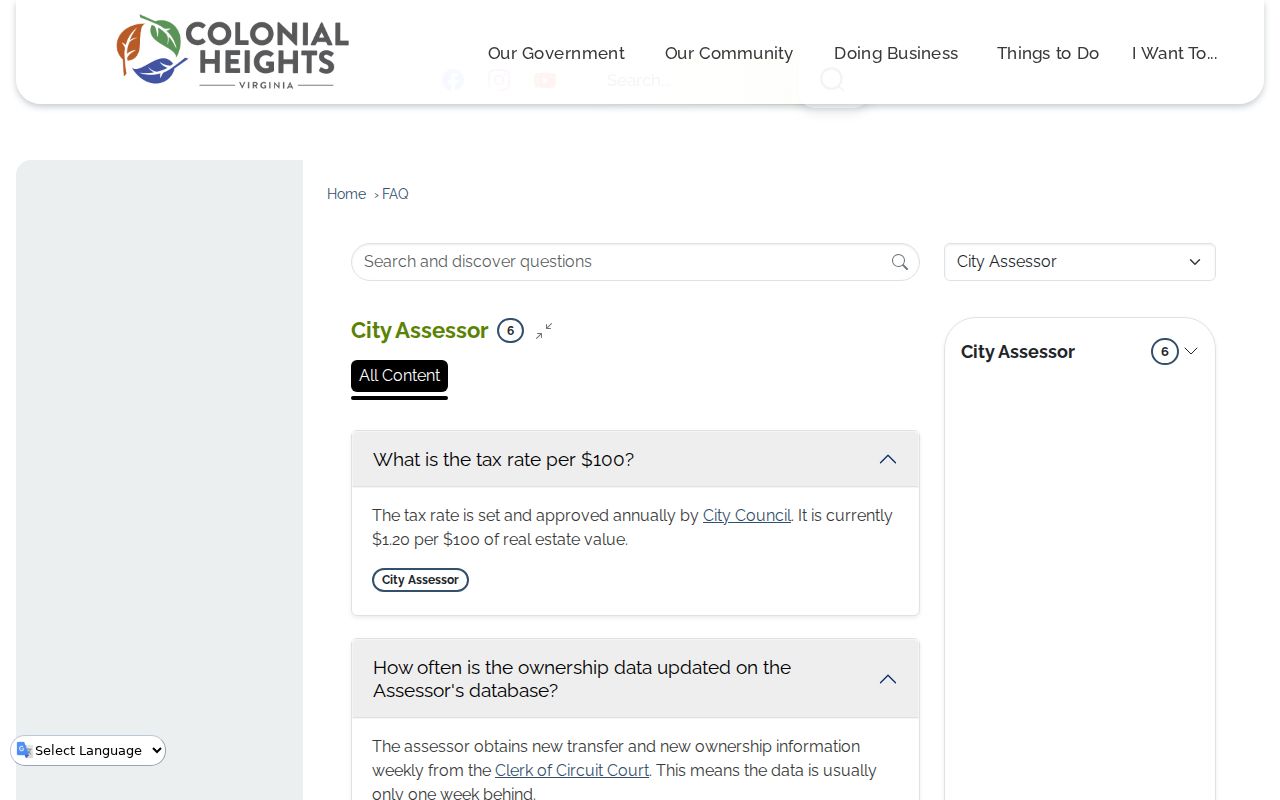
The FAQ supports the general two-year cycle. Confirm the current effective year in the City's land book and any recent reassessment notice.
Tax Ownership Is Set on January 1
Colonial Heights taxes real property for the full year to the owner of record on January 1. That tax-year owner may not hold the parcel later. A sale does not split the City's annual bill. Proration between buyer and seller is the settlement attorney's job. City guidance also covers escrow and warns that a missing bill does not erase the due dates or potential penalty and interest. A closing statement may show a proration. That adjustment is separate from the City account. Ask Billing & Collections whether the May or November payment has posted before treating a parcel as current. Keep three facts distinct on any bill. The deed date shows when ownership transferred. January 1 sets who is named for the annual assessment. The payment balance lives with Billing & Collections, which can confirm any posted payment. Never infer the current owner from a tax bill alone. The Clerk's latest recorded deed is the better source. Use it for any recent transfer.
The Colonial Heights Rate and Value Are Separate
The assessor FAQ posts a real-estate rate of $1.20 per $100 of value. The rate is one input. The parcel's assessed value and account status are separate inputs. A higher or lower assessment alone says nothing about the amount due, whether installments were paid, or whether a penalty is posted. Most assessments rely on verified sales comparison, per the City. The result is a mass valuation for local taxation. It is not a private appraisal or a buyer's offer. For the gap between assessed value, market indication, and recorded sale consideration, see the Colonial Heights property-value page. Check the live FAQ for the current rate. Ask the Assessor for the parcel's value year. Never carry a tax rate forward without confirming its effective period.
Find the Colonial Heights Bill and Balance
The City's real-estate tax page lays out payment rules rather than a property-by-property bill search. Give the address or parcel ID when contacting Billing & Collections. Staff can then find the right account. A bill notice may never arrive. Yet the owner remains responsible for the due date and amount.
- Open the City's real-estate tax guidance and note the due dates and sale-year rule.
- Call Billing & Collections at (804) 520-9320 with the address or parcel ID to confirm the current balance.
- Ask whether a payment, penalty, or interest charge is posted to that parcel.
- At a sale, have the settlement attorney address proration and payment of the year's taxes.
- Assessed value
- The Assessor's value used in the real-estate tax calculation.
- Tax rate
- The stated charge per $100 of assessed real-estate value.
- January 1 owner
- The person in whose name the City assesses the property for the full year.
- Tax lien
- A claim for unpaid real-estate tax that attaches to the land.
Unpaid Colonial Heights Taxes Follow the Land
Unpaid real-estate tax in Colonial Heights becomes a lien against the land. That lien follows the parcel. A buyer or owner should ask Billing & Collections for the current balance. Do not trust a mailed notice or a prior owner's statement. The City warns that a bill may never arrive. Penalty and interest can still apply.
The City publishes no online tax-sale list or parcel-balance screen. So verify two ways. Ask the billing office about the account status. Check the Circuit Court index for any recorded lien or related instrument. The official real-estate tax page explains due dates, escrow, and how a sale year is allocated. Treat it as general guidance, not a live tax account.
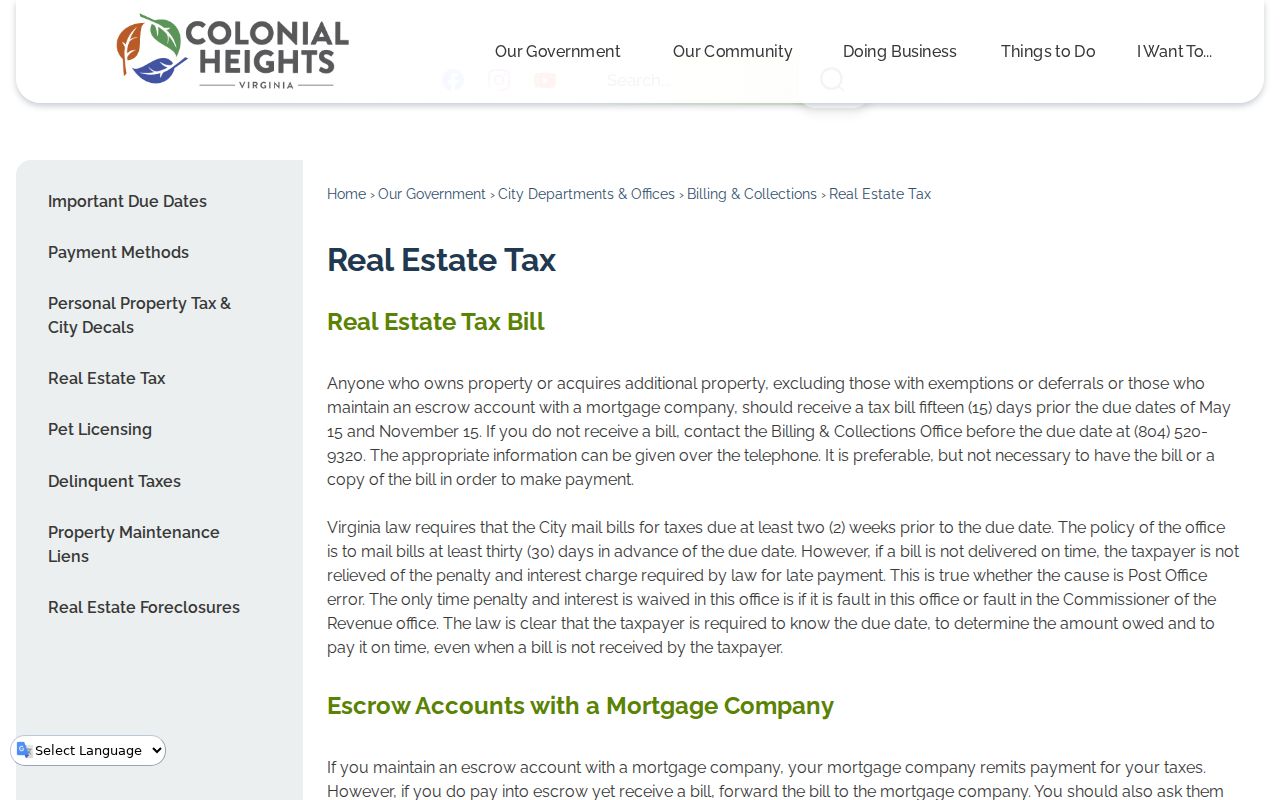
Contact Billing & Collections for the parcel's present amount and payment status.
What the Published Tax Page Does Not Show
The City's tax material offers a payment calendar, a January 1 ownership rule, sale-year guidance, escrow details, and the consequences of delinquency. What it lacks is account-level detail. There is no online parcel-balance screen, sample tax bill, exemption catalog, or current appeal schedule. Don't assume the portal has them. Other localities offer those tools; Colonial Heights does not.
Match each question to the right office. The Assessor and the current land book answer value questions. Billing & Collections answers bill questions. For an assessment dispute, ask the Assessor which review process and deadline apply to that tax year. Keeping those contacts separate saves time. It also keeps a general guidance page from being mistaken for an account record. The City posts current office contacts on its assessor page. Confirm the live instructions before sending a payment or appeal request.
Separate Colonial Heights Assessment and Tax Dates
One property file can carry four different dates, and each answers a different question. There is the assessment's effective date. There is the tax year. Then come the deed's recording date and a permit's closure or value-update date. The Assessor's weekly ownership feed can trail the deed by about a week, while the January 1 rule fixes the tax-year owner for the full-year assessment.
The 2026 land-book link takes effect May 1, 2026. The published FAQ names January 1, 2022 as the latest effective assessment. Check the current notice and book edition before calling a particular value current. Publication dates don't set every parcel's effective date.
Billing & Collections lists May 15 and November 15 due dates and serves as the source for a current balance. The City publishes no parcel-specific bill-result page. Call (804) 520-9320 with the parcel or account details to verify a balance, a posted payment, or a delinquency. Don't infer that from the assessed value.
What a Colonial Heights Tax Lien Follows
Unpaid real-estate tax becomes a lien on the land itself, according to the City. A deed sale does not wipe that question away. The parcel keeps its tax history no matter who signs the deed. So when you research a transfer in Colonial Heights property tax records, line up the tax year and the January 1 owner of record against the deed date, then call Billing & Collections to confirm the current payment status on the parcel.
No current appeal board, filing deadline, or appeal form appears in the City's published materials. The Assessor, at (804) 520-9272, can hand you the written procedure and the notice that apply to your parcel. Remember one point. A general reassessment year is not an appeal deadline by itself.
Check a Colonial Heights Assessment
The Assessor values Colonial Heights parcels by sales comparison. Reassessment runs on a biennial cycle. The City publishes no current appeal calendar, named review board, or filing deadline, so an owner with a dispute should go straight to the office. Anyone who believes the land-book description or value is wrong should contact the Assessor promptly. Ask which review steps and dates apply.
Confirm the current window. The published material reviewed here does not state an appeal deadline. Contact the City Assessor for the current procedure and preserve the notice, parcel description, and sales evidence before a local deadline passes.